


Vuyo Mxo reflects on her PhD fieldwork in Amadiba
In early 2025, I found myself in the Amadiba area, located along the breathtaking Wild Coast of the Eastern Cape Province. I had travelled there to conduct interviews with women weaving imizi – a local grass (Cyperus textilis) that embodies their craft, their heritage, their pride. But what I discovered went far beyond research. It was a journey of rediscovery, of being humbled, and of seeing myself reflected in the lives of others. I have never encountered a place so untouched, so authentic. The land itself is alive with rolling green hills that tumble into the sea, forests whispering old stories, and rivers that seem to hold memories in their flow. Yet it was the people who made the deepest impression on me. The Amadiba community is warm, deeply welcoming, and fiercely proud of who they are.
As a Xhosa woman from the central Eastern Cape, born and raised in rural villages, I thought I knew the meaning of “rootedness.” Growing up in such places shapes you, it teaches you good manners, perseverance, and the strength to carry yourself with dignity no matter where you go. But arriving in Amadiba made me realise something unsettling; in my years navigating modern, urban spaces, I had been softened, diluted. I had unknowingly adopted habits that pulled me away from the solid grounding my upbringing gave me. When I visited homes in the community, driving the organisation’s 4×4, families would insist that I park the vehicle right at the front. It was a public symbol – an announcement to the village that guests had arrived. Their pride in receiving visitors was palpable. Inside, I would be welcomed with warmth and generosity, a plate of food, conversation, laughter, sometimes even playful suggestions that I might consider marrying one of their sons. In those moments, I wasn’t just a researcher, I was embraced as kin.
What struck me most was how everything in Amadiba is truly homegrown. The soil, the water, the air – it all sustains life directly. During the interviews, I listened in awe as people shared knowledge passed down through generations. Their understanding of agriculture, ecology, and conservation was not only practical, but profoundly wise. Here were insights that I had spent years grasping at university working toward a PhD, yet they carried this wisdom naturally, woven into the rhythm of daily life. Leaving Amadiba, I carried more than interview notes. I carried inspiration and a renewed respect for indigenous knowledge. I saw how deeply it is tied to survival, dignity, and identity. And I left with a quiet resolve: to honour what I had witnessed, to learn from it, and to weave those lessons back into my own journey, just as the women of Amadiba weave strength and beauty into every strand of their imizi.
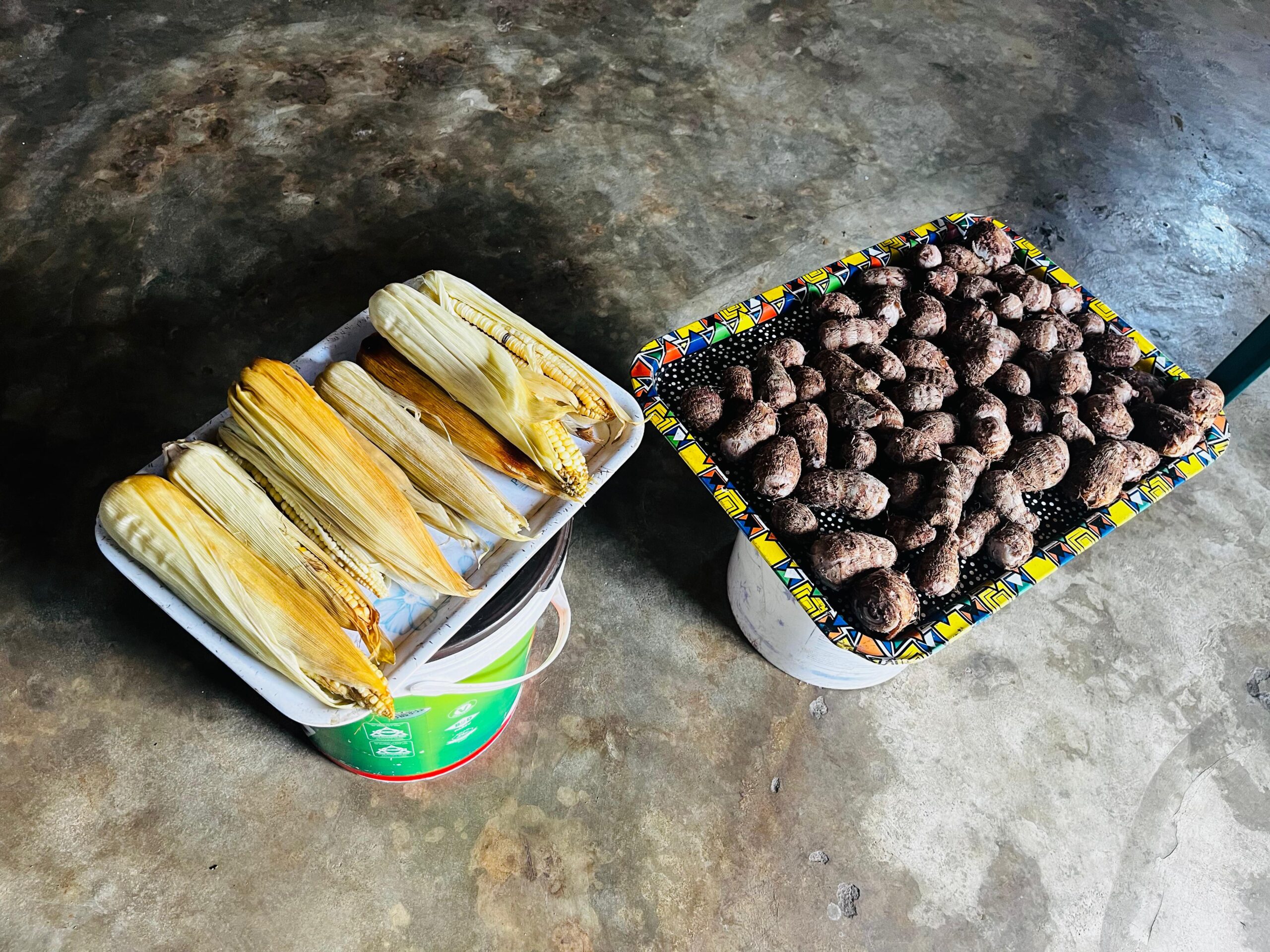
Traditional maize and amadumbe in the Amadiba Photo: Vuyo Mxo


 Taryn de Beer’s Masters thesis was titled “Stakeholder involvement in the development of genetically modified (GM) food labelling policy in South Africa”.
 Stephanie Joos-Vandewalle’s Masters thesis was titled “The effects of urbanisation on non-timber forest product dependencies: A case study of three settlements in the Chobe district of northern Botswana”.
 John Wilson’s Masters thesis was titled “The benefits and burdens of living beside the Cederberg Wilderness Area”.
 Helen Mahlase’s Masters thesis was titled “Exploring the uptake of genetically modified white maize by smallholder farmers: The case of Hlabisa, South Africa”.
 Claudette Muller’s Masters thesis was titled “The role of buchu (Agathosma betulina and Agathosma crenulata) cultivation in livelihoods and conservation”.
 Bonnie Galloway’s Masters thesis was titled “Impacts of commercialising Commiphora wildii in two conservancies in North Western Namibia”.
 Andrew Reid’s Masters thesis was titled “Rastas on the road to healing: Plant-human mobilities in Cape Town, South Africa”.


 skyrumbie@yahoo.co.uk