
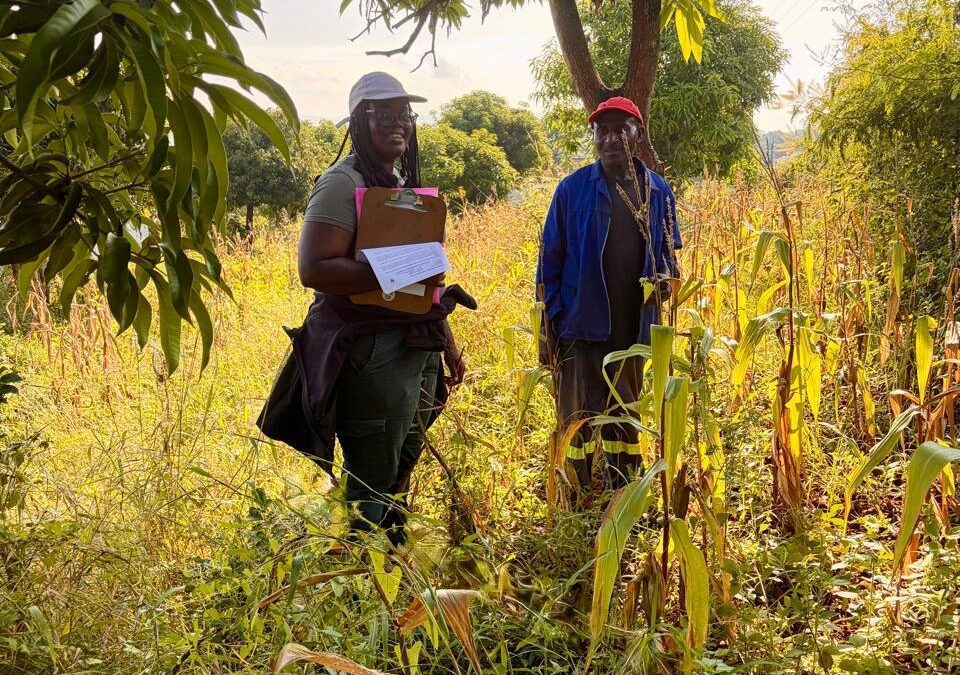

This reflection is drawn from my fieldwork on pest and disease literacy among smallholder maize farmers in Limpopo Province, South Africa.
I had designed my questionnaire carefully. It covered the common pests and diseases affecting maize in Limpopo: how farmers recognised them, what they did about them, and what they knew about managing them. Everything fitted neatly into categories. I thought I knew what pest and disease literacy looked like, and I was ready to measure it.
Then, somewhere between my questionnaire and a maize field, I realised that the questions were opening doors to answers I had not anticipated.
I have spent many years in agriculture, and like many researchers, I had come to think of knowledge as something that could be identified, questioned and measured. Ask farmers to identify a pest, recognise disease symptoms, or explain how they manage a problem, and their answers would tell me what they knew.
One afternoon, I worked through another questionnaire with a farmer. He had answered patiently and politely, but something about the conversation felt unfinished. My questionnaire had boxes for almost everything, except the answers that seemed to matter most.
I remembered that part of my approach was to use observation walks; to walk through the field with farmers and observe and discuss what they actually did. Almost instinctively, I closed my notebook and turned to my interpreter.
“Ask him to show us what he actually does when he notices something wrong in his field.”
The interpreter translated. The farmer paused, then began walking us through his field, showing us what he looked for, what he noticed, and what he did. The conversation changed immediately.
He spoke about a local maize variety his grandmother had always planted. Whether it was inherently more resilient or trusted after years of successful harvests, he could not be sure. But when pests appeared, or the rains failed, that was the seed he relied on.
He described a remedy made from local leaves that someone had taught him as a child. He did not know whether younger farmers still used it, but he had never stopped preparing it. It was simply part of how farming had always been done.
The conversation moved to the local agrodealers. Sometimes he followed the advice he received. Other times he did not, not because he questioned its effectiveness, but because pesticides were expensive, the shop was far away, or other household expenses came first.
Even though my questionnaire included questions intended to uncover these things, I realised that the answers I had been looking for were not necessarily the answers I needed to understand. They emerged when I stopped following the questions and listened to what the farmer was actually telling me.
That conversation stayed with me because it challenged something I had taken for granted. I had assumed that pest and disease literacy was primarily about scientific knowledge: recognising an insect, identifying disease symptoms, or recalling a recommended management strategy. But the farmers I met demonstrated something broader.
Their knowledge was built through observation, repeated seasons, inherited practices, conversations with neighbours, advice from agrodealers, trial and error, and memories passed from one generation to the next. It was practical, adaptive, and shaped as much by circumstance as by science.
As I continued interviewing farmers, I heard variations of the same story. Traditional maize varieties were often described as “stronger” or better able to withstand pests and difficult seasons. Whether these perceptions reflected measurable genetic resistance, local adaptation, or accumulated experience was not always clear. What was clear was that these beliefs influenced management decisions.
Likewise, recommendations from extension officers or agrodealers did not automatically translate into action. Knowing the supposedly “scientifically” recommended solution was only one part of the decision-making process. Farmers weighed that knowledge against affordability, product availability, labour requirements, previous experience, weather conditions, and the risks they were willing or able to take.
I began to realise that knowledge does not operate in isolation. It is constantly shaped by the realities of everyday farming.
It also made me rethink what literacy means.
Perhaps researchers sometimes mistake recall for understanding. Surveys reward correct answers because they are easy to measure. Farming, however, demands something different: making decisions under imperfect conditions.
A farmer who cannot recall the Latin name of an insect may still recognise the first signs of damage long before it becomes obvious. Another may never describe integrated pest management using technical language, yet combine crop rotation, resistant varieties, local remedies, and selective pesticide use to reduce risk.
Perhaps pest and disease literacy is not simply the ability to identify a pest or recite a recommendation. Perhaps it is the ability to recognise a problem, draw on different sources of knowledge, weigh competing constraints, and decide what to do next, not in ideal conditions, but in the conditions that actually exist.
That distinction changed the way I looked at my own research.
I do value scientific knowledge. Understanding pest biology, disease epidemiology, and integrated management remains essential. But I have become less interested in asking whether farmers can simply recite information and more interested in understanding how they navigate the decisions that farming demands every day.
Those decisions rarely fit neatly into a questionnaire. They emerge through stories: about grandparents and seed saving, about why a pesticide was not purchased that season, about memories of past outbreaks, and about the quiet confidence that comes from managing uncertainty year after year.
These are not simply anecdotes. They are evidence of how knowledge functions within real farming systems.
I am still analysing the data from this study, and I still have many questions to answer. But I now spend less time searching for gaps in farmers’ knowledge, not because those gaps do not exist, but because focusing on them alone can miss the bigger picture. Instead, I try to understand the systems within which knowledge is created, shared, adapted, and applied.
Perhaps the most important lesson I learned had very little to do with pests. It was about research itself.
Good research is not only about measuring what people know. It is about understanding how and why people make the decisions they do. And sometimes, the most valuable insight comes not from asking another question, but from putting the notebook down and simply listening.
That is a lesson I will carry into every study I undertake from here on.


 Taryn de Beer’s Masters thesis was titled “Stakeholder involvement in the development of genetically modified (GM) food labelling policy in South Africa”.
 Stephanie Joos-Vandewalle’s Masters thesis was titled “The effects of urbanisation on non-timber forest product dependencies: A case study of three settlements in the Chobe district of northern Botswana”.
 John Wilson’s Masters thesis was titled “The benefits and burdens of living beside the Cederberg Wilderness Area”.
 Helen Mahlase’s Masters thesis was titled “Exploring the uptake of genetically modified white maize by smallholder farmers: The case of Hlabisa, South Africa”.
 Claudette Muller’s Masters thesis was titled “The role of buchu (Agathosma betulina and Agathosma crenulata) cultivation in livelihoods and conservation”.
 Bonnie Galloway’s Masters thesis was titled “Impacts of commercialising Commiphora wildii in two conservancies in North Western Namibia”.
 Andrew Reid’s Masters thesis was titled “Rastas on the road to healing: Plant-human mobilities in Cape Town, South Africa”.


 skyrumbie@yahoo.co.uk