
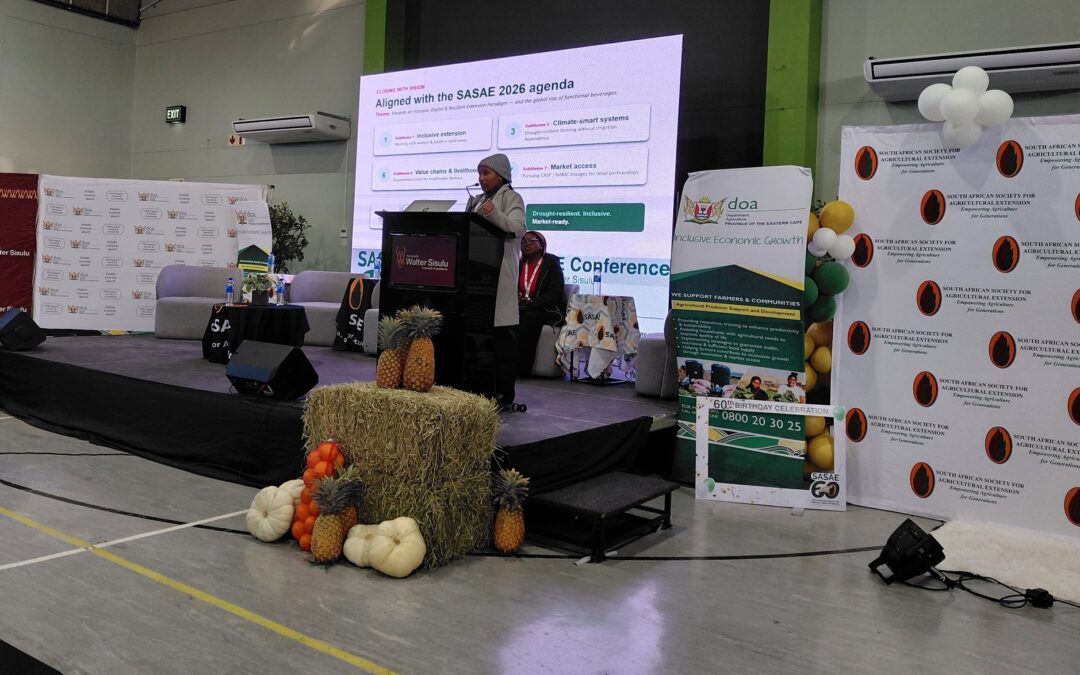

At the end of June 2026, I set off to KuGompo City (formerly known as East London) to attend the 59th Conference of the South African Society for Agricultural Extension (SASAE). The overarching theme of this year’s conference was: “Transforming Agricultural Extension for Sustainability, Climate-Smart and Resilient Rural
Development.” As a member of the Research for Agroecology Network Southern Africa (RAENS) team, I was tasked with introducing RAENS and recruiting members for the network, particularly those who might be influential in designing the curricula for extension advisors.
Driving out to the Potsdam campus of Walter Sisulu University, I was not sure about what to expect of the conference as I am not familiar with the field of agricultural extension. Since South Africa has such a powerful – indeed dominant – industrial agricultural sector, I was somewhat sceptical about my chances of recruiting members for an agroecology-based network.
I need not have been concerned. Among the approximately 400 delegates, many of those presenting papers or posters mentioned “sustainable agriculture” and related practices such as intercropping, mulching with biological waste materials, water harvesting, and improved grazing and livestock management.
Upon closer inspection, however, I realised that the majority of the students, researchers and extension advisors who presented their work equated sustainable agriculture to “climate smart agriculture” (CSA). For instance, traditional crops or farmers’ varieties such as cassava, pearl millet, and sorghum were referred to as “climate smart crops” and “climate-smart fertilisation” was described as a combination of conventional nitrogen application and bio-stimulants.
Although agroecology and CSA both fit under the umbrella term “sustainable agriculture,” there are marked differences between these two approaches. First defined by the FAO in 2010 as “agriculture that sustainably increases productivity, fosters resilience, reduces greenhouse gases, and enhances achievement of national food security and development goals,” CSA does not prohibit any agricultural practices, as long as they promote efficiency, boost productivity and contribute to the goals contained within the FAO’s definition (Gras and Cáceres 2020). Agroecology, on the other hand, disallows the use of chemical inputs such as fertilisers and pesticides which cause ecological harm, preferring to limit the use of purchased inputs altogether. And whereas agroecology values different knowledge systems and participatory knowledge development processes, CSA has been critiqued for its top-down technology transfer model which is largely controlled by transnational agricultural input companies (Gras and Cáceres 2020).
Whereas CSA can be described as an agricultural production system with sustainable components, agroecology comprises much more as it seeks to address social inequalities in the entire food system – from farm to fork – and recognises the diverse links between agrifood and social-ecological systems. For more on the RAENS network’s interpretation of agroecology, read the RAENS Position Paper, here.
Once I had announced that RAENS was promoting agroecology in the Southern African region, I was approached by several people – mostly young, female extension advisors – who wanted to learn more about the network. I also made contact with senior academics who had an interest in promoting sustainable agriculture among smallholder farmers in South Africa and therefore could play a valuable role in transforming agricultural extension curricula.
Overall, I found the conference participants to be respectful of the knowledge held by the smallholder farmers they work with. And although there are critical differences between CSA and agroecology, I left with a sense of hope that these young minds could become advocates for agroecology once they receive the right training and mentorship.
REFERENCES
FAO 2010. “Climate-Smart” Agriculture: Policies, Practices and Financing for Food Security, Adaptation and Mitigation. Rome: Food and Agriculture Organization of the United Nations: 68.
Gras, C. and Cáceres, D.M. 2020. Technology, nature’s appropriation and capital accumulation in modern agriculture. Current Opinion in Environmental Sustainability, 45: 1-9. https://doi.org/10.1016/j.cosust.2020.04.001


 Taryn de Beer’s Masters thesis was titled “Stakeholder involvement in the development of genetically modified (GM) food labelling policy in South Africa”.
 Stephanie Joos-Vandewalle’s Masters thesis was titled “The effects of urbanisation on non-timber forest product dependencies: A case study of three settlements in the Chobe district of northern Botswana”.
 John Wilson’s Masters thesis was titled “The benefits and burdens of living beside the Cederberg Wilderness Area”.
 Helen Mahlase’s Masters thesis was titled “Exploring the uptake of genetically modified white maize by smallholder farmers: The case of Hlabisa, South Africa”.
 Claudette Muller’s Masters thesis was titled “The role of buchu (Agathosma betulina and Agathosma crenulata) cultivation in livelihoods and conservation”.
 Bonnie Galloway’s Masters thesis was titled “Impacts of commercialising Commiphora wildii in two conservancies in North Western Namibia”.
 Andrew Reid’s Masters thesis was titled “Rastas on the road to healing: Plant-human mobilities in Cape Town, South Africa”.


 skyrumbie@yahoo.co.uk