
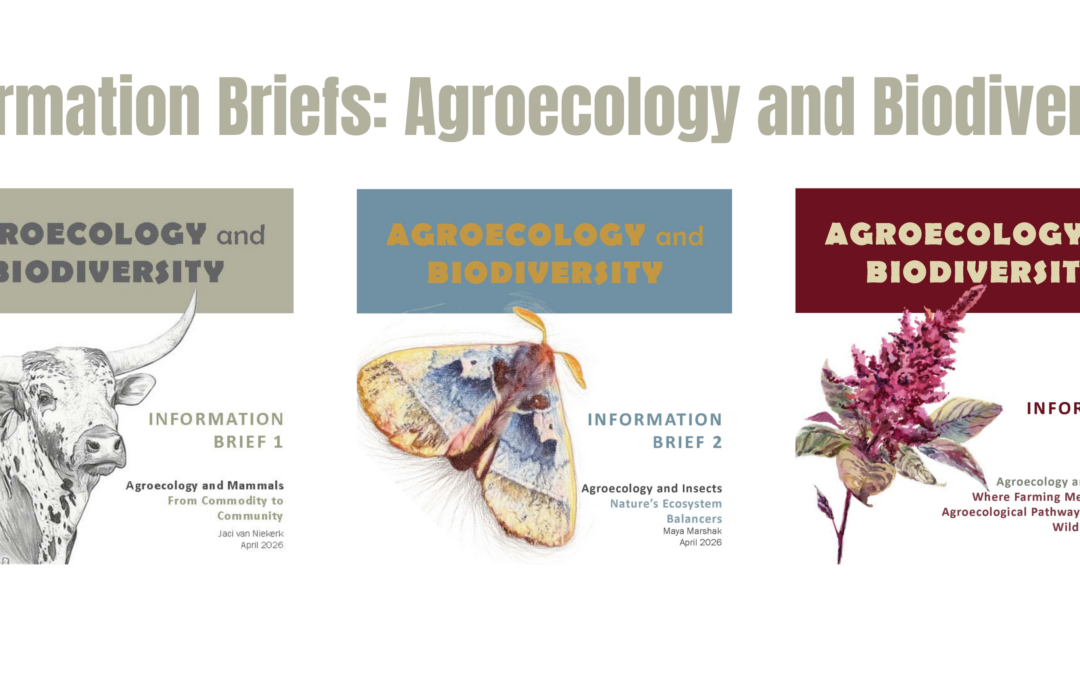

With support from the Seed and Knowledge Initiative (SKI), members of the Bio-economy Chair have produced three information briefs examining the linkages between agroecology and biodiversity. Set against an alarming backdrop of accelerating global biodiversity loss, the briefs explore ways in which an agroecological approach to farming can stem this loss and provide alternatives which enhance diversity on and off farm.
In the first brief researcher Jaci van Niekerk explores the relationships between agroecology and mammals; in the second, postdoctoral fellow Maya Marshak looks at the intricate links between insects and agroecology; and in the third, postdoctoral fellow Jessica Lavelle unpacks the vital connections between wild foods and agroecological farmscapes.
The lives of mammals – domesticated and wild
In industrial farming systems, the focus is on a select few mammalian species such as cattle, sheep, pigs, goats, and rabbits. In contrast, agroecology views all animals – including mammals – as important components of the “web of life.” This brief traces the importance of domesticated mammals in integrated agroecological farming systems and underlines the critical need for taking into consideration their health, welfare and wellbeing. The brief also looks at the roles played by wild mammals in agroecological systems, finding that many perform functions that farmers find useful such as pollination and seed dispersal. The brief concludes with a set of recommendations for preserving mammal diversity in agroecological landscapes.
Intercepting an insect extinction
Many people hold negative views of insects as they have been known to carry disease and infest crops. These perceptions underlie industrial agriculture’s “pest” label and drive a multi-billion-dollar synthetic pesticide industry which is deeply destructive to insect populations. Besides the increasing use of pesticides, habitat transformation, climate change and the spread of alien invasive vegetation have caused scientists to raise the alarm about an imminent insect extinction. In contrast, agroecological farming’s strong emphasis on protecting diversity in its many forms includes insect diversity. Not only do insects provide agricultural ecosystem services such as pollination or assist farmers by breaking down plant material for use in organic compost, they may also be a nutritious food source. The brief ends with a list of recommendations for gardeners and farmers who would like to nurture the insect diversity on their land.
Farming, foraging, fishing and hunting
Between 10 000 and 12 000 years ago, many humans exchanged their hunter-gatherer lifestyles for a more sedentary way of life based on farming. This does not mean, however, that they stopped foraging, fishing and hunting altogether. Nor does it mean that members of contemporary hunter-gatherer and forager cultures don’t farm. In this brief, Dr Jessica Lavelle explores these integrated, interdependent and complementary food systems within the context of agroecology. Wild foods include a vast array of edible plants, animals, and fungi found on land, and in marine and freshwater environments. Although located in the “wild” these foods may well be managed, tended or manipulated to increase their productivity and availability. Use of different wild foods requires specialised cultural knowledge regarding harvesting, preparation, cooking, preservation and other forms of processing. Once they reach the table, wild foods may be served in isolation, or in combination with either other wild foods or farm-derived meats or plants, thereby providing nutrient-dense and culturally important foods. The brief concludes with recommendations for strengthening agroecology and its support of wild foods.
Click on the cover images below to download the briefs.


 Taryn de Beer’s Masters thesis was titled “Stakeholder involvement in the development of genetically modified (GM) food labelling policy in South Africa”.
 Stephanie Joos-Vandewalle’s Masters thesis was titled “The effects of urbanisation on non-timber forest product dependencies: A case study of three settlements in the Chobe district of northern Botswana”.
 John Wilson’s Masters thesis was titled “The benefits and burdens of living beside the Cederberg Wilderness Area”.
 Helen Mahlase’s Masters thesis was titled “Exploring the uptake of genetically modified white maize by smallholder farmers: The case of Hlabisa, South Africa”.
 Claudette Muller’s Masters thesis was titled “The role of buchu (Agathosma betulina and Agathosma crenulata) cultivation in livelihoods and conservation”.
 Bonnie Galloway’s Masters thesis was titled “Impacts of commercialising Commiphora wildii in two conservancies in North Western Namibia”.
 Andrew Reid’s Masters thesis was titled “Rastas on the road to healing: Plant-human mobilities in Cape Town, South Africa”.


 skyrumbie@yahoo.co.uk